
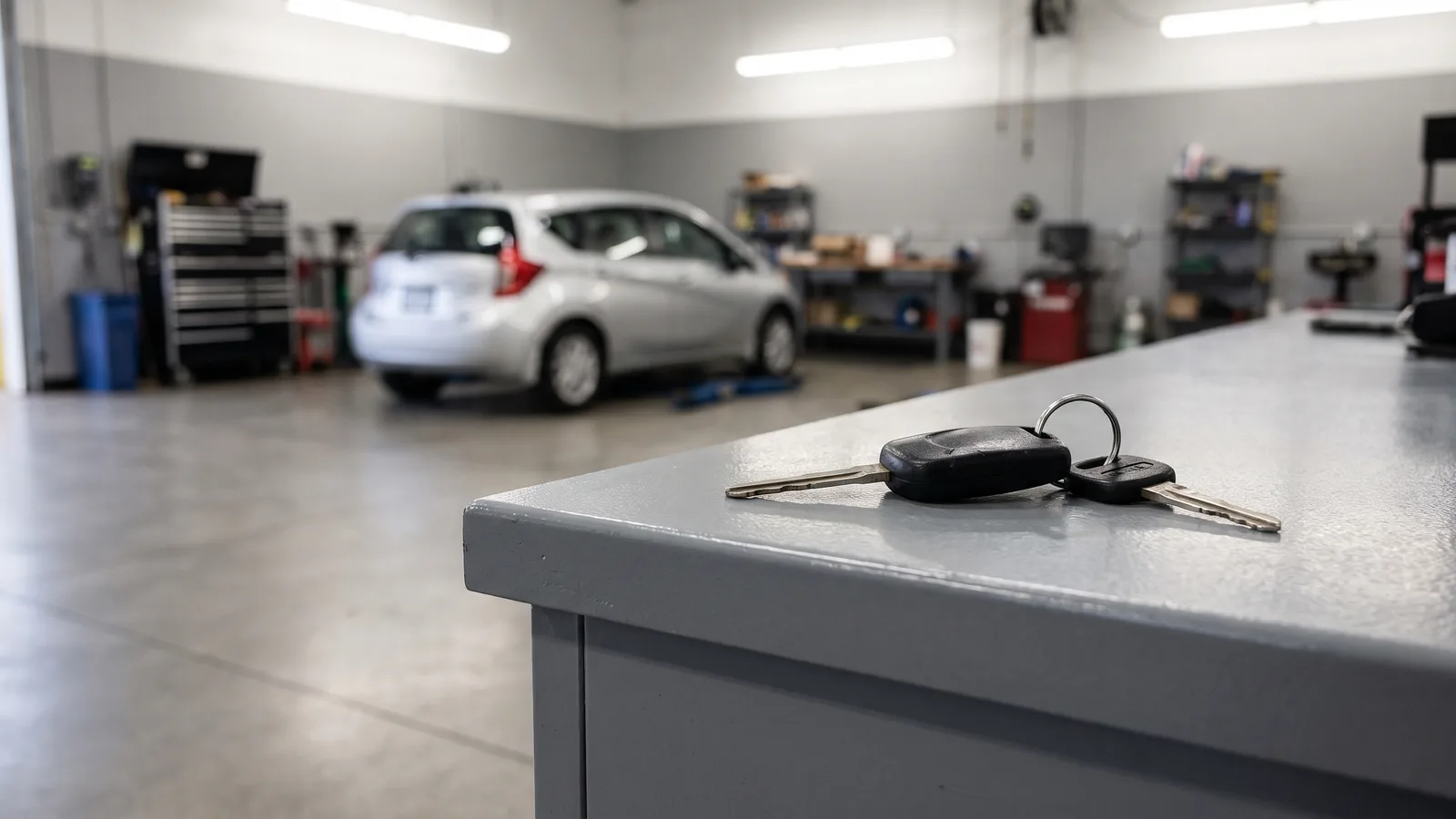
If the accident was not your fault, you are entitled to a like for like replacement vehicle, paid for by the at fault driver’s insurer. If it was your fault, you get a courtesy car only if you bought courtesy car cover on your own car insurance policy, and it will usually be a small hatchback whatever you normally drive.
Those are two completely different things, and the fact that everyone calls both of them a courtesy car is why so many people end up with the wrong vehicle, or none at all.
This guide is for drivers whose car is off the road after a car accident and who want to know what they can insist on. It covers what a courtesy car is, when you are automatically entitled to one, how credit hire differs and what it can cost you if it goes wrong, how long you can keep it, and what to do when the at fault insurer says no. We are an accident repair centre rather than an insurance company, so this is written from the side that actually hands over the keys.
What does courtesy car mean?
A courtesy car is a temporary replacement vehicle lent to you while your own car is being repaired. It usually comes from the repair garage, rather than your insurer providing a courtesy car directly.
The word courtesy is doing a lot of work there. It implies a favour, and on your own policy that is roughly what it is: a service your insurer has agreed to provide, on their terms, if you paid for it. After a non fault accident it is not a favour at all, which is the distinction the rest of this guide turns on.
It is also worth knowing that no garage is legally required to lend you a temporary vehicle. There is no statutory right to one in the UK, which is why what your own motor insurance policy says matters so much.
Courtesy car insurance: what cover on your own policy gives you
Courtesy car insurance is the version most people have in mind, and the version most often misunderstood.
Is courtesy car cover included as standard?
Sometimes, but less often than people assume. Most comprehensive car insurance policies include a courtesy car option, though whether it is built into the premium or sold as an optional extra varies by insurer, and a comprehensive policy may still charge an additional cost for it. Not all policies include courtesy car cover at all, so check your policy details. Third party cover almost never includes it.
Insurance courtesy cars also come with conditions. The repair usually has to be done at an approved garage in the insurer’s network, there may be a minimum repair duration before one is offered at all, and cover frequently excludes windscreen or glass damage claims. You normally need to be at least 21, sometimes 25, and hold a full licence.
What courtesy vehicle will you get?
A small hatchback, in most cases. Standard courtesy cars tend to be a supermini such as a Corsa or Fiesta, regardless of whether you normally drive a van, an estate or something considerably larger.
That matters more than it sounds. If you have three children in car seats or you carry tools for work, a small hatchback is not a replacement car in any practical sense, even though it technically satisfies the policy. Most courtesy cars are chosen for the garage’s fleet costs, not for your life.
Availability is finite too. A repair garage runs a small pool of these, so you often need to book a temporary replacement car in advance, and “we have cover” does not always mean “we have one free today”.
Hire car cover as an upgrade
Some insurers sell hire car cover separately, which is a different and usually better product than basic courtesy car cover. A hire vehicle under that kind of comprehensive cover typically offers broader protection, is more likely to match the size of your own vehicle, and is commonly available for a set period such as 21 to 28 days after a claim.
If you drive something a supermini cannot replace, that upgrade is worth pricing at renewal.
Are you automatically entitled to a courtesy car?
On your own policy, no. You get one only if you hold the cover, and only on its terms.
After a non fault accident, the position reverses completely. You are entitled to a replacement, and the at fault party’s insurer pays for it.
Do you get a courtesy car if the car accident was not your fault?
Yes, and this is where most people are short changed.
Under tort law, whoever causes a loss has to put you back in the same position you were in beforehand. If their driver took your car off the road, leaving you without transport is part of the loss they caused. A like for like replacement is the remedy, not a goodwill gesture.
Like for like means broadly the same size and type as yours. If you drive an estate you should be offered an estate, and if you drive a larger car or a van for work you should be offered the same. Being handed a supermini because that is what the network had spare is not the same thing, and you can say so.
In a genuine non fault claim there should be no upfront cost at any stage, no insurance excess, and no effect on your own policy. That is consistent with how the rest of a non fault claim works, covered in who pays for a non-fault accident repair.
Courtesy car versus credit hire: the difference that matters
If your replacement after a non fault accident is arranged through a credit hire company rather than lent to you by a local garage, the arrangement is fundamentally different, even though the car on your driveway looks the same.
| Courtesy car | Credit hire vehicle | |
|---|---|---|
| Who provides it | Your repair garage | A credit hire company |
| Who pays | Your insurer, if you have cover | Recovered from the at fault insurer |
| What you get | Usually a small hatchback | Like for like with your own vehicle |
| Whose name is on the agreement | Nobody signs a hire contract | Yours |
| If the claim fails | Nothing to pay | You can be liable for the bill |
That last row is the whole point, and it is the row the industry is quietest about.
What is a credit hire car?
A credit hire car is a hire vehicle provided to a non fault driver on credit, with the charges claimed back from the other driver’s insurer afterwards.
Nothing is paid upfront, which is why it is offered so readily. But you are the hirer. The agreement is between you and the hire company, and the claim against the third party insurer is how that agreement is expected to be settled.
Why is credit hire so expensive?
Because credit hire rates sit well above standard rental rates. The hire company carries the cost, the delay and the risk of recovering from an insurer who will argue about it, and that is priced in.
Insurers dispute these charges regularly, which is exactly why the exposure matters to you rather than staying a fight between two companies.
The credit hire risk nobody explains
If the at fault insurer refuses to pay, or a court decides the hire ran too long, or liability is never established, the hire company can pursue you for the difference. You signed the agreement.
This is not theoretical. The Financial Ombudsman Service publishes guidance on complaints about credit hire and credit repair after a no fault accident, and the cases it describes include people who were never told they were claiming outside their own insurance policy, people who had the risks left unexplained, and people for whom credit hire was simply unsuitable.
Three questions are worth asking before signing anything. This is the key point of the whole guide:
- Is this a courtesy car or a credit hire agreement? Ask directly and get the answer in writing.
- Am I liable if the claim is not recovered in full? If yes, ask what the daily rate is.
- Has liability been admitted yet? Credit hire before the other side accepts fault carries noticeably more risk.
A repairer who will not answer those three plainly is telling you something.
Courtesy car rules in the UK
There is no single national rulebook. What governs you is your insurance cover on an at fault claim and the law of negligence on a non fault one. In practice the rules you meet are these:
- A full valid licence, and usually a minimum age of 21 or 25
- The car is for your use, with other drivers added only by agreement
- Return it with the same fuel level you received, and pay your own fuel and tolls
- No smoking, and pets are generally not allowed
- Mileage limits may apply, and unlimited mileage is not a given
- Parking fines and speeding penalties are yours
- Return it as soon as your own car is ready
How long can you keep a courtesy car?
Until your car is repaired and ready to collect, in the normal case. Not until you feel like bringing it back.
On a non fault claim the hire should run as long as you reasonably need it, including waiting for parts and waiting for the insurer to authorise the work. You do have a duty to keep that period reasonable, so returning it promptly protects the claim as well as being good manners.
There is more on realistic timescales in how long does an accident repair take.
Can you get a courtesy car if your car is written off?
This is the single biggest gap in most policies. Cover typically applies while your car is being repaired, and a written off car is not being repaired, so most courtesy car arrangements end when the total loss decision is made, sometimes with only a short grace period after it.
On a non fault claim the position is better. You should keep a replacement vehicle until the at fault insurer pays your settlement, because until that money arrives you cannot replace your car. Given that first offers are often low, this can matter for weeks. See what happens if your car is written off.
How much does a courtesy car cost?
On a genuine non fault claim, nothing. The at fault insurer carries it.
On your own policy, the cover is a modest optional extra on the premium and the car is then provided at no extra cost during the repair. You still pay fuel. There is sometimes a deposit, and there is usually an excess if you damage it.
Are you insured to drive a courtesy car?
Usually yes, but check who arranged it. Insurance is typically provided through the garage’s motor trade policy or a separate insurance arranged with the vehicle, rather than extending automatically from your own cover.
Ask what the excess is before you drive away. It is often higher than the excess on your own policy, and it is the number that bites if anything happens. Our guide to what an insurance excess is explains how those figures work.
What happens if you have an accident in a courtesy car?
Report it as you would in your own car. You are generally liable for the excess on whatever policy covers that vehicle, and depending on who arranged the cover and whose fault it was, it may affect your no claims discount.
Photograph the car when you collect it. Existing damage you did not record is hard to argue about later.
Will a courtesy car affect your car insurance premium?
Having the car does not, in itself. The claim behind it can.
An at fault claim affects your premium whether or not you took the car. A non fault claim settled directly against the other insurer should not touch your no claims discount at all, which is one of the stronger arguments for keeping your own policy out of it. There is more in will a non-fault claim affect my insurance.
How long does it take to get one?
Often the same day, sometimes within 24 to 48 hours, depending on availability and on how quickly liability is confirmed. After a non fault accident the delay is usually the insurer rather than the car.
Can you use a courtesy car for work?
For commuting, normally yes. For business use, carrying goods, or anything commercial, check first, because many agreements exclude it on the same terms. If you need a van or a camper van replaced, say so at the outset rather than accepting a car and hoping.
What to do if the at fault insurer says no
Insurers sometimes offer less than a like for like replacement, dispute how long you need one, or offer a cash payment instead. None of that is final.
- Tell their claims team what you actually drive, and why a smaller vehicle does not meet your needs. Be specific: seats, access, load space, work use.
- Get the refusal in writing, with their reasons.
- Keep every receipt for taxis, trains and car hire while you are without a vehicle, because those costs are recoverable.
- Do not accept the first offer if it leaves you worse off than before the accident.
- Make a formal complaint. Their own process first, then the Financial Ombudsman Service, which is free to use.
How MSL Customs handles it
We arrange a replacement vehicle while your car is with us, and on a non fault claim we deal with the at fault insurer directly so you are not negotiating for it yourself. We are not an insurer and not an approved repairer on anyone’s network, which is precisely why we can tell you what you are entitled to rather than what a network would prefer you accept.
We will also tell you plainly which kind of vehicle you are being offered and on what terms, including whether anything you are asked to sign makes you the hirer. If credit hire is right for your situation we will say so, and if it is not, we will say that too.
Tell us what happened and we will sort the car and the claim together. There is no cost for the advice and no obligation. You can also read how non-fault claims work.
This is general guidance, not legal or financial advice. What your own policy provides is set by your insurer and shown in your documents.
Had an accident, or need a repair?